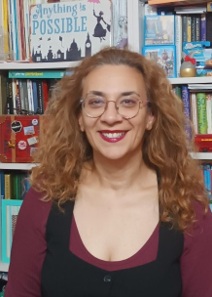
Short Bio: Maria Doulgeri is an English language teacher, writer and. She holds a BA in English Language and Literature (Aristotle University of Thessaloniki), a BA in History and Archaeology (Aristotle University of Thessaloniki) and an MEd specialising in Educational Technology (Hellenic Open University). With extensive experience across diverse educational contexts, she has taught in secondary, primary, and, more recently, pre-primary education settings. She is the co-author and illustrator of the ‘Big Books for Little People’ series, comprising four picture books for very young English learners. Her interests focus on playful methodological approaches to language learning, with an emphasis on storytelling through drama, Art and crafts, and the integration of digital tools and Generative Artificial Intelligence (GenAI) tools in teaching practices.
Short Bio: Angeliki Voreopoulou is an English language teacher, teacher trainer, children’s book writer and European projects coordinator. She holds a BA in English and English Language (University of Kent at Canterbury), an MEd in TEFL (University of Bristol), an MSc in Immersive Technologies (Democritus University of Thrace) and she is a PhD candidate at the Aristotle University of Thessaloniki. She has significant experience in both primary and secondary levels of education and a broad understanding of pedagogical approaches across age groups. She believes that students can learn so much better when introduced to colour, music, games and storytelling. Her main interests include storytelling, visual materials and the use of immersive technologies (AR and VR) into the classroom. She shares her practice in conferences, seminars and workshops.
Title: “Once upon a time…”: Experiential Storytelling practices for Early Childhood English Language Teaching within the EAN Project
Abstract: Storytelling is one of the most powerful tools in foreign language teaching, as it transforms a simple teaching hour into a meaningful learning experience. What happens when a teacher brings a storybook into the classroom? Young learners stop being passive recipients of knowledge and become active participants immersing themselves into a world that sparks their natural curiosity and engages them cognitively, emotionally and physically. Grounded in the principles of the EAN Project, this workshop aims to motivate participants to integrate experiential storytelling into their teaching practice by exploring a rich repertoire of hands-on storytelling techniques, including storytelling aprons, puppets, masks, pop-up books and language games that transform a simple lesson into a memorable language learning experience. Emphasis will be given on building emotional connections with stories and their leading characters, while promoting active participation and creating a supportive and inclusive environment, where language can be used with confidence. By the end of the workshop participants will have gained a set of practical, ready-to-use activities and guidance on selecting and adapting storybooks for diverse early learning contexts so as to transform their teaching space into a world of storytelling, discovery, and authentic language. The workshop welcomes teachers at all stages of their professional journey and is designed as an interactive, collaborative experience that encourages reflection and open dialogue.
Duration: 60 minutes
Number of participants: 25–30
Materials: All workshop materials will be with us
Other infrastructure: Computer and projector
Short Bio: Valentina Sokratous has been working as a Museum Coordinator since 2018 and as Head of Museum Learning since 2011 at the Ethnological Museum of Thrace. She first joined the museum in 2007 as a facilitator. She designs and implements community programs and workshops for diverse groups, using a variety of techniques and participatory approaches. She has also worked as a cultural manager in projects and interventions that focus on social change through the arts. She holds a degree in Education and an MSc in Innovative Approaches in Education in Multicultural Environments. She is an alumna of the START – Create Cultural Change program (Goethe-Institut Thessaloniki & Bosch Foundation, 2019–2020) and was selected as a fellow of the U.S. State Department for the International Visitor Leadership Program (IVLP) in 2021 and 2023, titled “Promoting Social Change Through the Arts.” She has created/curated and participated in several performance art projects.
Title: Sorry. No English !
Abstract: What is the role of museums and cultural spaces in supporting the learning of English in kindergarten? This experiential workshop invites participants to explore ways in which museums can function as rich learning environments for introducing and developing basic English vocabulary among young learners. Through collaborative activities and co-design processes, participants will develop ideas for educational activities and possible teaching scenarios that make use not only of museum exhibits and their labels but also of the museum space itself as a stimulus for language learning. Emphasis will be placed on experiential and multisensory approaches that connect cultural exploration with early foreign language learning.
Number of participants: 15
Materials: 2-meter chart paper, markers, Post-it notes, (electric hot plate, saucepan, sesame seeds, honey, baking paper, wooden spoon)
Other infrastructure: Recommended venue: Ethnological Museum of Thrace – Alternatively, a room with chairs and 2 tables

Short Bio: Vasiliki Bistina is a preschool teacher who has worked for several years in preschools attended by students with multilingual backgrounds. She holds a degree from the Department of Preschool Education Sciences and Educational Design at the University of the Aegean, as well as a degree from the Department of Foreign Languages, Translation and Interpreting at the Ionian University, with English and French as her official working languages. She also holds a Master in Education with the use of new technologies from the University of the Aegean. She is currently a PhD candidate at the Department of Early Childhood Education of the Democritus University of Thrace. Her research interests focus on multilingual education in early childhood, second/foreign language teaching in early childhood and the CLIL (Content and Language Integrated Learning) approach.

Short Bio: Maria Davi is an English language teacher with a five-year experience in teaching in kindergarten settings. She holds a Bachelor’s degree in English Language and Literature from Aristotle University of Thessaloniki and a Master’s degree in Technologies in Education from the Open University of Cyprus. Throughout her professional career, she has been involved in designing and implementing English language lessons for young learners, applying experiential and play-based teaching methods. She also integrates digital tools into the learning process, aiming to enhance communicative approaches to language teaching. Her academic and professional interests include early childhood English language teaching, educational technology, and innovative pedagogical practices. She is fluent in English and has a good command of French.
Short Bio: Dr. Lydia Mitits holds an MA in TEFL and a PhD in Applied Linguistics. She is an Assistant Professor in the Department of Education Sciences in Early Childhood at Democritus University of Thrace, Greece, where she teaches courses on bilingualism in education, second language acquisition, and pragmatics, among others. Dr. Mitits possesses an extensive academic background, having presented at numerous international conferences and published peer-reviewed research in prominent books, international journals, and conference proceedings. With professional experience teaching English as a Foreign Language (EFL) across primary, secondary, and tertiary education, she has also delivered various invited talks and led professional development workshops for in-service teachers. Her primary research interests include bilingualism and multilingualism in education, language learning strategies, heritage languages, multilingual language development, and language teaching methodology.
Title: “A trip to Europe” in practice: Teacher collaboration, challenges, adaptations and “children’s voices” in the preschool classroom.
Abstract: This workshop presents the implementation of the educational scenario “A trip to Europe” from the book Teacher collaboration in practice: Examples of creative integration of English in the preschool classroom (Alexiou & Penderi, 2025) in a preschool classroom, highlighting the role of collaborative teaching between the classroom teacher and the English language teacher. The scenario was developed within the framework of interdisciplinary and experiential learning. The presenters will outline the rationale for selecting this particular scenario and its connection to the preschool curriculum. They will describe the planning and implementation stages of the scenario, emphasizing the different levels of collaboration between the two teachers throughout the process, from the initial planning and classroom implementation to reflection and evaluation. Drawing on authentic photographic documentation from the classroom, participants will gain insight into the practical aspects of the learning activities, the materials used and how children engaged with the learning experience. The workshop will also reflect on the outcomes of the experience by discussing what worked well, the challenges that emerged during the process and the adaptations made in response to the specific needs and dynamics of the class. Special attention will be given to capturing and interpreting “children’s voices”, presenting children’s reflections on their learning experience, what they believe they learnt or achieved, what they enjoyed most, how they felt during the implementation and what they would like to explore further. The workshop will conclude with interactive activities to explore how educational scenarios from this book can inspire collaboration between teachers and support creative adaptation in their own school contexts.
Number of participants: 25–30
Materials: Colored A4 paper, pens, colored Post-it notes
Other infrastructure: Computer, projector