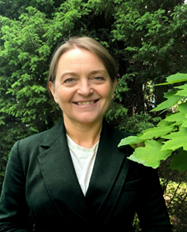
Short Bio: Dana an educator with many years of experience. She has taught in primary schools, served as a school principal, and has long been engaged in the development of education at all levels. She is a professor of pedagogy, the author of several textbooks, and a researcher who has participated in dozens of national and international projects. She transforms experience from both practice and research into concrete solutions for schools and teachers. Her work focuses mainly on the development of critical thinking, multicultural and language competences of both children and teachers, FLT in primary education, and the comparison of educational systems. The strategies she applies in FLT can also be effectively transferred to programs for acquiring Slovak as a second language, making them accessible, natural, and easy to understand. In 2024, she published the textbook Languages in a Playful and Meaningful Way for primary school teachers. In 2025, she co-authored the methodological guide Kamarátka slovenčina – a language program for children with a different mother tongue.”
Title: Approaches to teaching foreign languages in a playful and meaningful way (Slovak projects)
Abstract: The presentation presents two projects on FFL in Slovakia, emphasizing that teaching foreign languages to young learners must be grounded in an understanding of how children naturally acquire language. These projects build language teaching and a specific language program on the following teaching paradigm: Language learning at school should resemble native language acquisition as closely as possible. A key principle is child-centered, developmentally appropriate FL teaching. Instruction should match children’s cognitive and emotional development and respect their individuality. Lessons need to be age-appropriate, playful, experiential, and free from fear, creating a safe and motivating environment. Language should be taught primarily through communication and meaningful use, not isolated grammar drills. Children learn best when language is embedded in real-life contexts, stories, games, songs, and physical activities. Methods like Total Physical Response (TPR) and CLIL help connect language with movement and sensory experience. The process of learning follows a natural sequence similar to first language acquisition: listening → speaking → reading → writing. Early exposure to rich input (hearing the language) is crucial before expecting production. The teacher plays a central role as a facilitator who creates engaging activities, uses diverse materials (including stories and digital tools), and supports learners with constructive feedback. Assessment should be encouraging, focusing on progress rather than errors. Finally, the approach should be inclusive, recognizing different learning needs and promoting cooperation, respect, and positive attitudes. Overall, effective teaching combines scientific insights with creative, interactive practice that makes language learning enjoyable and meaningful for children.

Short Bio: Loukia Taxitari is Assistant Professor of Experimental Psychology in the Department of Psychology, Neapolis University, Paphos. She holds a degree in Greek Philology from the University of Athens. In 2004 she received an M.Phil. in General Linguistics and in 2009 she received a PhD in Experimental Psychology from the University of Oxford, United Kingdom. She specializes in language acquisition and development and uses a range of experimental methods to investigate language processes. She has worked as a postdoctoral researcher in Cyprus (University of Cyprus, Cyprus University of Technology), Germany (Potsdam University) and Italy (CNR, Pisa), applying various techniques to the study of language in various populations. She adapted the MacArthur–Bates CDI to Cypriot Greek and contributed to the development of new methodologies for language research, including tablet-based applications. She has taught extensively at public and private universities in Cyprus and has published articles and book chapters, presenting her work at international conferences. She serves as an associate editor for the European Psychologist, a reviewer for scientific journals and the annual CogSci conference. She is the editor-in-chief of Fact Check Cyprus, and in addition to factchecking, she emphasizes media literacy education as well as disinformation research.
Title: Linguistic and Cognitive Benefits of Early Second Language Exposure: Research Evidence and Implications for Kindergarten Education
Abstract: Early exposure to a second language has been extensively examined in psycholinguistics and developmental cognitive psychology. This presentation focuses on the linguistic and cognitive benefits associated with systematic second language exposure in early childhood, drawing on research findings from the past decades. At the linguistic level, early bilingual experience has been linked to enhanced metalinguistic awareness, increased sensitivity to language structure and improved ability to distinguish and process linguistic forms. Exposure to more than one linguistic system also appears to foster an understanding of language variability and to promote positive attitudes toward language learning at future developmental stages. At the cognitive level, research has identified associations between early bilingualism and aspects of executive functioning, including cognitive flexibility, inhibitory control and task-switching abilities. Although findings are influenced by multiple contextual factors, evidence suggests that meaningful and developmentally appropriate second language exposure may contribute positively to broader cognitive development. The discussion focuses on the implications for the introduction of English in kindergarten settings, emphasizing the importance of pedagogically informed practices that align with children’s developmental needs.

Short Bio: Marina Tzakosta is a full Professor at the Department of Preschool Education, Faculty of Education, University of Crete and a member of the teaching staff of the Hellenic Open University. She holds a BA and a Master’s Δegree from the University of Crete and a Ph.D. from the Leiden University Center of Linguistics (NL). The focus of her research is L1 development and L2 teaching & learning. Her research interests expand to dialectal evolution and the relation of dialects to standard Greek as first and second languages. She conducted postdoctoral research at the University of Patras with a grant awarded by the Greek State Scholarships Foundation. She has been a visiting fellow at UMass/ Amherst, Princeton University, U.S.A. (with a grant awarded by the Stanley Seeger Center for Hellenic Studies) and Simon Fraser University, Canada (grant awarded by the Greek State Scholarships Foundation). She has been the principal investigator or the research associate in 27 research and educational programs.
Title: How easy or possible is the introduction of English in dialectal-speaking environments?
Abstract: The introduction of English in preschool education is an innovative reformation which refreshes education and reinforces inter-cultural education especially at the level of the incorporation of foreign-languages-speaking children in preschool classes. However, there are very few studies focusing on the benefits stemming from the introduction of English in dialectal-speaking environments in which linguistic varieties other than standard Greek are the mainly spoken languages. In my presentation I discuss the data which are the product of a questionnaire directed to 93 preschool children, boys and girls, who are enrolled in urban, rural and semi-rural kindergartens of Crete. The questionnaire was filled in by the researchers who discussed with the children. In these environments, Cretan Greek is the natural language. It is worth-mentioning that, despite their limited exposure to English, the children have very positive attitudes towards the introduction of English in preschool education. They express clear attitudes regarding a) why they like English more than Greek, b) why they would like to have ‘more English’ in class, c) why they think other children also like English. More data will underline the value of English as a lingua franca in environments of intra-language variation and as a tool of intra-national inter-cultural teaching.

Short Bio: Dr Julie Waddington is Associate Professor (Serra Húnter) in Language and Literature Education at the University of Girona. Her work focuses on foreign language teaching in childhood education and issues related to learner and teacher identity. She is author of the book Questioning the native speaker construct in teacher education, (Routledge, 2025), and has published widely in journals such as Cambridge Journal of Education; Language, Culture and Curriculum; System; ELT Journal; and European Early Childhood Education Research Journal.
Title: Empowering early childhood educators to move beyond native speaker ideologies
Abstract: This talk explores how the figure of the “ideal native speaker” continues to shape beliefs about language teaching, even though current foreign language education policies promote plurilingualism and reject native speaker norms as the ultimate model. Drawing on a study conducted with preservice teachers in Early Childhood Education at a university in Catalonia, I examine how strongly this ideal persists and how it influences future teachers’ perceptions of themselves and their professional roles. The study analysed data collected during a core module that integrates an innovative approach to introducing English in the early years. The findings reveal that most pre-service teachers still hold assumptions that privilege native speaker norms and, in doing so, reproduce deficit views of non-specialist teachers. These beliefs not only contradict current educational policies but also risk reinforcing disempowering and discriminatory attitudes in early language education. At the same time, post intervention results show that when students engage in reflective work – while simultaneously developing linguistic and didactic competences – their views begin to shift. The talk highlights the importance of fostering this reflective dimension in teacher education and argues for collaborative practices in which all linguistic abilities are valued. Ultimately, it calls for a more inclusive understanding of who is qualified to teach languages in early childhood settings.